Wednesday, 10 October 2018

European shares fall as uncertainty prevails; tech, luxury hit

 European shares fell on Wednesday as investors assessed whether worries about global growth warranted the caution that led Wall Street and Asian markets to trade sideways the day before.
The tech sector was the worst performer, with Austrian chipmaker AMS (S:AMS) falling close to 7 percent and STMicroelectronics (PA:STM) down about 4 percent.
Luxury stocks were rattled by fears of a Chinese slowdown and a Morgan Stanley(NYSE:MS) "underweight" call on luxury stocks.
"We are seeing more investors opting to wait and see how risks surrounding rising U.S. treasury yields, global growth and China play out", Jasper Lawler of LCG wrote in a morning note.
Shares in France's LVMH (PA:LVMH) fell 4.2 percent, even though its fashion and leather goods unit did better than expected in the third quarter .
Concern over ebbing demand by Chinese consumers for branded goods have hit luxury stocks in recent days, as a trade war between Beijing and Washington simmers.
The pan-European STOXX 600 index (STOXX) was down 0.36 percent by 0819 GMT. Germany's DAX (GDAXI) retreated 0.52 percent and France's CAC 40 (FCHI) lost 0.7 percent.
Britain's FTSE (FTSE) dropped 0.27 percent as reports of progress in Brexit negotiations led to gains by sterling, which would hit the overseas revenues of British companies. Luxury group Burberry (L:BRBY) fell 4.4 percent.
In Italy, Milan's FTSE MIB (FTMIB) recovered after an initial fall and rose 0.1 percent despite heavy losses from luxury clothing company Moncler (MI:MONC), down 5.2 percent.
Italian banks (FTIT8300) jumped 1.6 percent as yields on the country's sovereign debt fell after Italian Economy Minister Giovanni Tria confirmed budget forecasts and said he expected a collaboration with the European Union over the budget.
Shares in VAT Group (S:VACN) posted the worst performance overall on the STOXX 600, down 10.2 percent. The Swiss industrial valves manufacturer said it would shorten work for some employees as demand softened in certain markets.
Devamını Oku

Monday, 8 October 2018

S&P Closes Flat in Rollercoaster Session

The S&P 500 shut level Monday as worries over rising U.S. security yields and a wobble in worldwide markets weighed on supposition.

The Dow Jones Industrial Average rose around 0.16%. The S&P 500 shut level, while the Nasdaq Composite fell 0.67%.

Stocks ripped at back the majority of their misfortunes minutes before the nearby, even as innovation stocks succumbed to offering weight in the midst of financial specialist fears that U.S. government security yields will keep on rising, scratching interest for less secure speculation like stocks.

Letters in order (NASDAQ:GOOGL) stock was in the spotlight in late-evening exchange in the midst of a one-two punch of negative reports.

CNBC detailed, refering to executives at numerous media offices, that promoters were jettisoning Google scan for Amazon (NASDAQ:AMZN) advertisements, while The Wall Street Journal said the tech mammoth concealed a product glitch on its web-based social networking stage, Google+, which had uncovered the information of around 500,000 clients.

U.S. Treasuries, which did not exchange on Monday as the security showcase was closed for Columbus Day, rose to multi-year highs a week ago, starting an auction in stocks.

The bearish estimation in stocks was underlined by a bounce in the alleged dread file, or CBOE Volatility Index, on the back of a wobble in worldwide markets.

European markets drooped on Italy spending concerns, while Chinese stocks saw sharp decreases, even as the People's Bank of China (PBOC) presented ace market measures on Sunday.

There were some splendid spots, in any case, as financials attached gains on a rally in banks, some of which report quarterly income in the not so distant future.

JPMorgan Chase (NYSE:JPM), Citigroup (NYSE:C) and Wells Fargo (NYSE:WFC) shut higher.
Devamını Oku

Sunday, 7 October 2018

Week Ahead: U.S. Yields At 7-Year High Put Stocks Under Temporary Pressure

Week Ahead: U.S. Yields At 7-Year High Put Stocks Under Temporary Pressure

  • Stocks fall on Friday as NFP paves way for higher rates
  • But solid data, best labor market in 50 years prove economy can withstand tightening
  • Dollar falls below uptrend line, again
Though we predict that US stocks will continue to hit fresh records longer-term, on Friday all major indices—the S&P 500Dow Jones Industrial AverageNASDAQ Composite and Russell 2000—slipped lower, as US equity markets experienced their worst week in a month.
Strong economic data during the course of the week, including a robust Services PMI, expanding Factory Orders and an almost 50-year low Unemployment Rate helped fuel speculation of continued Fed rate hikes. As well, Treasury yields continue to rise, spurring investors to sell riskier stocks in favor of safer bond holdings.
Additional headwinds for stocks last week included the ongoing escalation of the US-Sino trade dispute. Still, despite the removal of unprecedented accommodation, the healthy economic outlook together with "perhaps the best" labor market in 50 years, according to Gus Faucher, chief economist at PNC, signal equities will have more room to run.

Treasurys Sell Off, Equities Follow As Yields Rise

UST 10-Y Weekly
UST 10-Y Weekly
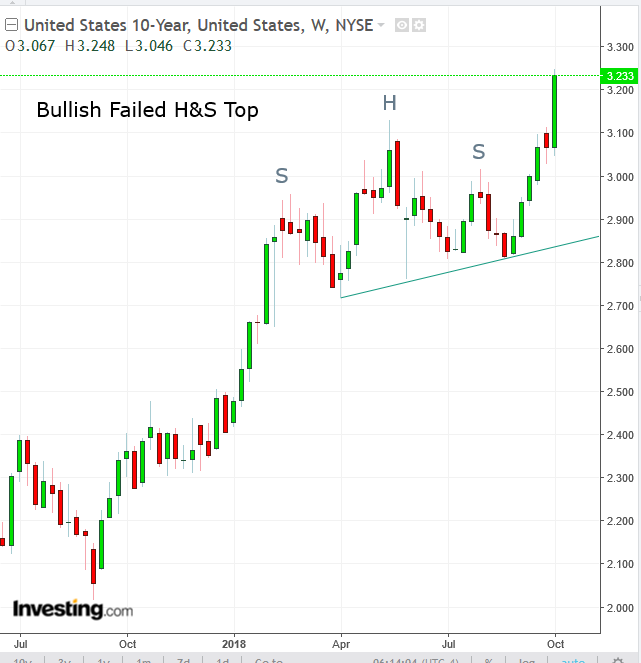
Nevertheless, strong economic data compounded by a hawkish statement from Fed Chair Powell drove a Treasury selloff, pushing 10-year yields to their highest levels in seven years. Although Friday's employment report disappointed on job creation, it hit the lowest unemployment level since 1969, reinforcing the Fed's path for interest rates, deepening the US bond selloff and pushing the yields to above 3.2, the highest since May 2011.
Technically, 10-year yields formed an H&S top between mid-February and mid-August. However, its blowout reverses all the localized downward pressure, turning it into an upward catapult, establishing an outlook for continued rallies for bond yields.
On Friday, S&P 500 fell Friday 0.55 percent. Nine of the index's 11 sectors turned red, led by Technology shares (-1.23 percent). Utilities (+1.53 percent) was the only sector that advanced. The benchmark index retreated 0.87 percent for the week.
The Dow Jones Industrial Average slumped 0.68 percent on Friday, dragged down by Intel (NASDAQ:INTC) which lost more than 2 percent of value after Bloomberg reported on Chinese hacking via tiny microchips used to steal intellectual secrets from large US companies and government contractors. For the week, however, the Dow was flat, falling just 0.04 percent.
The NASDAQ 100 plummeted 1.21 percent for a weekly setback of precisely 3 percent.
Russell 2000 Daily
Russell 2000 Daily
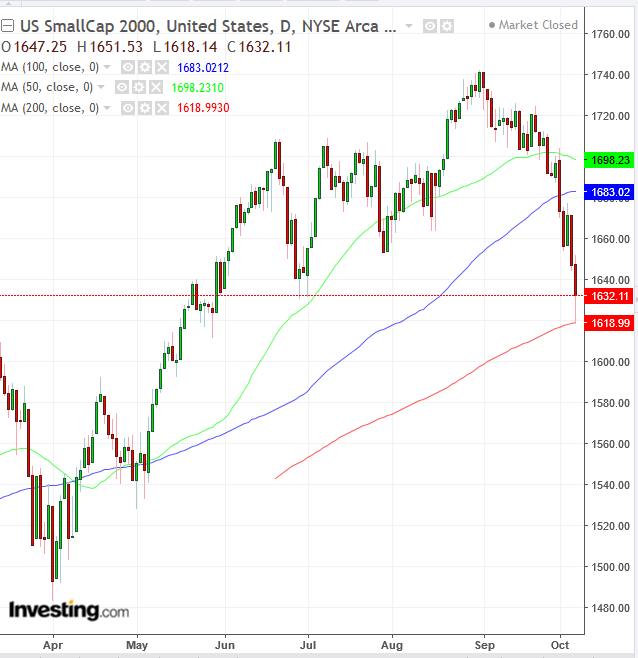
The Russell 2000 fell 0.9 percent on Friday, finding support above the 200 DMA. It plunged 3.8 percent on a weekly basis, making it the clear laggard for the week, finding support above the 50 WMA. Losses were triggered by the so-called NAFTA 2.0 agreement, officially the US-Mexico-Canada (USMCA) deal that was signed early last week, which makes the flow of goods smoother for multinationals manufacturing or sourcing materials in those countries.Technically, the price has closed at the lowest level since May 29 and is threatening a top reversal.
The Dollar Index fell for a second day on Friday, after the NFP missed on job creation. The global reserve currency fell back below its uptrend line since May 14.
Oil Daily
Oil Daily
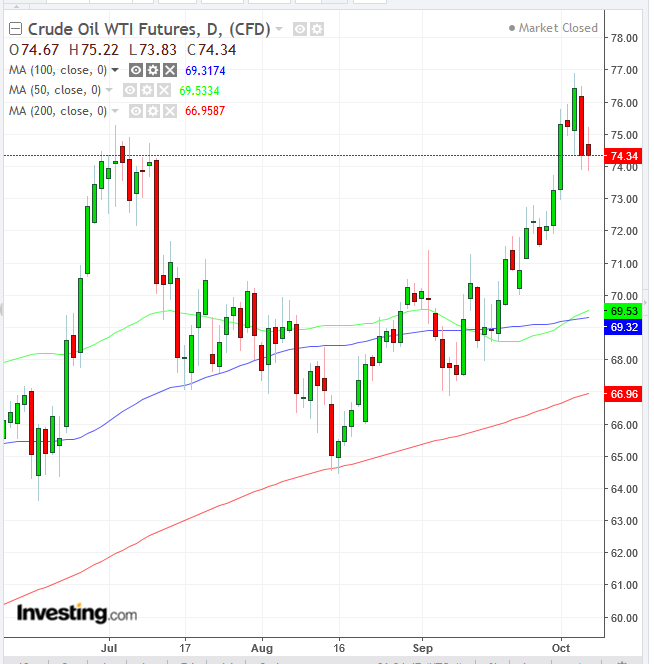
Crude oil slipped back toward $74, after nearing $77 on Wednesday. Markets brushed off a rise in crude oil inventories after data showed that US stocks jumped close to 8 million barrels last week, quadruple analyst expectations and the most significant build since March 2017.
Investors remain bullish on the commodity because of the November 4 start of US sanctions against Iran which will remove that countries oil from the global supply. Even China, which tends not to play ball in this arena—and is in perhaps the most significant dispute with the US right since it shot down a US plan during the Bush administration in 2001—has cut down its oil purchase from Iran by half. Technically, the price registered a new peak, confirming the uptrend; the 50 DMA also crossed above the 100 DMA.
Devamını Oku

Saturday, 6 October 2018

Vivendi reaffirms support for TIM CEO, decries 'rumor campaign'

Top shareholder Vivendi (PA:VIV) reaffirmed its support for Telecom Italia's (TIM) (MI:TLIT) Chief Executive Amos Genish, while accusing activist fund Elliott of running a "rumor campaign" to discredit him.
The French media group, which owns 24 percent of TIM, has been at loggerheads with Elliott since the U.S. hedge fund took a stake in Italy's biggest phone group earlier this year and ended up wrestling board control away from Vivendi in May.
The battle of words has intensified in recent months as TIM fell under pressure due to tougher competition at home, which in turn prompted speculation that Genish's position at the company could be at risk.
Shares in TIM are down around 30 percent so far in 2018, worse than a 15 percent fall in the European telecoms index (SXKP).
"Vivendi supports TIM's CEO Amos Genish unreservedly and values his contribution," Vivendi said on Saturday, confirming comments also reported by Italian media on Saturday.
"We believe that this vicious rumor campaign is orchestrated by Elliott, whose lack of organization is bringing down Telecom Italia ," added Vivendi.
The attack follows a similar move last month when Vivendi said TIM's performance had been "disastrous" since Elliott seized control of the Italian firm's board.
When contacted by Reuters on Saturday, Elliott referred to the statement it had released in response to Vivendi's previous accusations in September.
At the time, Elliott said Vivendi had "fallen prey to the 'short-termism' it has previously decried", casting judgment on the new board just four months after it was appointed.
It also told the French group that TIM was executing a plan that was "devised and approved by Vivendi" and urged the French group to work toward constructive solutions at the board level.
Under Genish, who was appointed when Vivendi controlled the board, TIM is working on a three-year turnaround plan focusing on a digital transformation and fixing the group's finances.
However, the former state phone monopoly has been facing growing challenges in both fixed and mobile: Broadband group Open Fiber is rolling out a rival fiber optic network while French telecoms group Iliad (PA:ILD) in May launched its low-price mobile offer for Italy.
TIM also committed this week to spending more than 2.4 billion euros ($2.77 billion) - much more than initially expected - on fifth-generation mobile spectrum in Italy, in a move that is likely to raise its debt pile and could affect its ambition to return to an investment grade credit rating next year.

Devamını Oku

Friday, 5 October 2018

Wall Street Slips as Investors Digest Jobs Numbers

Money Street battled for bearing on Friday as the market considered a fall in U.S.unemployment rate to a level unheard of since 1969, but rather likewise a more regrettable than-anticipated ascent in nonfarm payrolls.

The S&P 500 was about level, down 0.85 point, or 0.03%, to 2,900.76 starting at 10:00 AM ET (14:00 GMT), while the Dow fell 7.68 focuses, or 0.03%, to 26,619.80 and the tech-substantial Nasdaq Composite was down 22.67 focuses, or 0.29% to 7,856.84.

The U.S. economy made less occupations than anticipated in September, however joblessness came to a 48-year low, demonstrating the economy was nearing full business. In the interim, desires for a Federal Reserve rate increment in December climbed somewhat to 77.7%.

After the information discharge, the yield on the benchmark United States 10-Year Treasury note bounced to 3.227%, a level unheard of since 2011.

Medicinal maryjane firm Tilray (NASDAQ:TLRY) was among the best gainers, rising 4.63%, while Snap (NYSE:SNAP) rose 1.03% after a report that its CEO set a benefit objective for 2019. In the mean time, General Electric (NYSE:GE) increased 3.50% and Facebook (NASDAQ:FB) crept up 0.15%.

Somewhere else, Tesla (NASDAQ:TSLA) drooped 3.49% after CEO Elon Musk scrutinized the Securities and Exchange Commission in a questionable tweet. Apple (NASDAQ:AAPL) plunged 0.29%, while Costco (NASDAQ:COST) diminished 2.73%.

In Europe stocks were down. Germany's DAX drooped 111 focuses, or 0.91%, while in France the CAC 40 diminished 42 focuses, or 0.79%, and in London the FTSE 100 was down 78 focuses, or 1.06%. In the interim the container European Euro Stoxx 50 lost 21 focuses, or 0.63%, while Spain's IBEX 35 fell 51 focuses, or 0.55%.

In products, gold fates rose 0.41% to $1,206.50 a troy ounce while unrefined petroleum fates were level at $74.33 a barrel. The U.S. dollar file, which estimates the greenback against a container of six noteworthy monetary forms, fell 0.14% to 95.30.


Devamını Oku

Thursday, 4 October 2018

Wall Street hammered by surging bond yields

 Wall Street tumbled on Thursday, mirroring a slump in global financial markets, as U.S. Treasury yields surged to multi-year highs on robust economic data and upbeat comments from the Federal Reserve, sparking fears of accelerating inflation.
The Dow Jones Industrial Average (DJI) dropped for the first time in six days and, along with the benchmark S&P 500 (SPX), was on pace for its biggest one-day drop since late June. The Nasdaq dived nearly 2 percent, dragged down by a drop in heavyweight stocks.
Nine of the 11 major S&P sectors were lower. The communication services sector (SPLRCL) slumped 1.93 percent, with Alphabet (O:GOOGL) and Netflix (O:NFLX) dropping more than 2.5 percent each, while Facebook (O:FB) slid 2.80 percent.
Technology stocks (SPLRCT) declined 2 percent and were the biggest drag on the markets. Apple (O:AAPL) fell 1.87 percent.
Healthcare (SPXHC) and consumer discretionary (SPLRCD) groups also lost more than 1 percent.
The yield on the benchmark 10-year note (US10YT=RR) was perched at seven-year high as strong economic data on Wednesday raised expectations that the non-farm payrolls report due on Friday morning would come in stronger than anticipated. [US/]
Of particular interest will be the wage growth for September, especially in the light of Amazon.com (O:AMZN) raising its minimum wage to $15 earlier this week.
"I will be more interested in the wage growth figure, as another surprise to the upside will fuel expectations that inflation will run above the targeted 2 percent and the Fed may need to tighten policy faster than previously projected," said Hussein Sayed, chief market strategist at FXTM.
The financial sector (SPSY) gained 0.45 percent as the yield curve – the spread between two- and 10-year yields – steepened to a two-month high. Bank stocks <.SPXBK> jumped 0.52 percent.
At 12:53 a.m. EDT the Dow Jones Industrial Average (DJI) was down 266.09 points, or 0.99 percent, at 26,562.30, the S&P 500 (SPX) was down 30.21 points, or 1.03 percent, at 2,895.30 and the Nasdaq Composite (IXIC) was down 161.77 points, or 2.02 percent, at 7,863.32.
The CBOE Global Markets volatility index (VIX), known as Wall Street's "fear gauge", rose 3.55 points, its highest surge in more than three weeks.
Despite the pullback, U.S. stocks are trading near record levels, raising concerns about valuations with the earnings season just around the corner.
"The equity market are seeing bonds as more of a competition but I don't think there is anything structural here. I think it's more of a pause for equities," said Tony Roth, chief investment officer at Wilmington Trust in Wilmington, Delaware.
Among gainers, Constellation Brands (N:STZ) shares rose 4.59 percent after the Corona beer maker raised its full-year profit forecast and topped Wall Street's estimates for second-quarter sales and profit.
Eli Lilly (N:LLY) shares gained 3.07 percent after the company's experimental diabetes drug showed promise in a mid-stage trial.
Declining issues outnumbered advancers for a 4.61-to-1 ratio on the NYSE and a 3.76-to-1 ratio on the Nasdaq.
The S&P index recorded eight new 52-week highs and 17 new lows, while the Nasdaq recorded 20 new highs and 76 new lows.

Devamını Oku

Wednesday, 3 October 2018

Money Street moves as financials gain, however off prior highs

Money Street ascended on Wednesday, with the Dow Jones Industrial Average hitting a record high for a second day after monetary information helped Treasury yields and lifted budgetary stocks.

The ADP National Employment Report demonstrated private payrolls bounced by 230,000 occupations in September, the biggest gain since February, while a report from the Institute for Supply Management indicated administrations area action hit a 21-year high in September.

The information helped yields on the 10-year U.S. Treasury note (US10YT=RR) hit its largest amount in more than seven years at 3.179 percent and the two-year yield (US2YT=RR) contacted its most elevated amount in over 10 years as desires for a rate climb from the U.S. Central bank in December solidified.

The ascent in yields helped support financials, which thus put the S&P 500 inside striking separation of a record. Financials were additionally supported by signs Italy would cut its spending shortage and lower its obligation in the coming years, facilitating a worry that had constrained worldwide securities exchanges.

Financials (SPSY), which have failed to meet expectations the more extensive market this year, rose 0.78 percent, on track for their greatest day since Sept. 20.

"Recently you saw Treasuries rally in view of a tad of that dread from abroad yet now you are seeing that inflatable flying to oblige the numbers we have here," said Mark Kepner, value broker at Themis Trading in Chatham, New Jersey.

"The work information was very solid, the ADP report, that was unquestionably high on everyone's radar concerning what it will be on Friday."

The Dow Jones Industrial Average (DJI) rose 56.05 focuses, or 0.21 percent, to 26,829.99, the S&P 500 (SPX) increased 1.35 focuses, or 0.05 percent, to 2,924.78 and the Nasdaq Composite (IXIC) included 24.19 focuses, or 0.3 percent, to 8,023.74.

Dealers currently observe a 78.8 percent possibility of a 25 premise point climb at the December meeting of the Fed, up from 77.4 percent seven days back, as indicated by CME's FedWatch device.

Utilities (SPLRCU), off 1.80 percent and land <.SPLRCR>, down 1.61, were driving the decliners, as higher security yields made offers of high-profit paying organizations less appealing.

Major lists had started to lose steam heading into the last phases of exchanging, be that as it may, and were fortunate their session highs.

General Motors (N:GM) rose 2.4 percent after Honda Motor (T:7267) said it would put $2 billion more than 12 years in the U.S. carmaker's Cruise self-driving unit.

Michael Kors (N:KORS) rose 3.1 percent after Citi updated the stock on desires its ongoing buy of Italian form house Versace would support execution.

Propelling issues dwarfed declining ones on the NYSE by a 1.02-to-1 proportion; on Nasdaq, a 1.72-to-1 proportion favored advancers.

The S&P 500 posted 29 new 52-week highs and 14 new lows; the Nasdaq Composite recorded 37 new highs and 59 new lows.

Devamını Oku
Ethereum Price Analysis

Ethereum Price Analysis

Key Highlights
  • ETH price failed to gain momentum above $232 and declined recently against the US Dollar.
  • This week’s followed important bullish trend line was breached with support at $225 on the hourly chart of ETH/USD (data feed via Kraken).
  • The pair is currently in a bearish zone and it could continue to move down towards $207 or $203.
Ethereum price is grinding lower against the US Dollar and bitcoin. ETH/USD may well accelerate losses towards $203 if sellers remain in control.

Ethereum Price Analysis

There was a strong hurdle faced near the $232-234 zone by ETH price against the US Dollar. The ETH/USD pair failed to gain momentum, started a downside move, and broke the $228 and $225 support levels. During the decline, there was a break below the 50% Fib retracement level of the last major upward move from the $213 low to $239 high.
More importantly, this week’s followed important bullish trend line was breached with support at $225 on the hourly chart of ETH/USD. The pair is now trading well below the $225 support and the 100 hourly simple moving average. It seems like the price may continue to move down towards the $213 low in the near term. If sellers clear the $213 low, there could be more losses towards the $207 level. It represents the 1.236 Fib extension level of the last major upward move from the $213 low to $239 high. Further below this, the price may perhaps test the last major swing low at $203.
Ethereum Price Analysis ETH Chart
Looking at the chart, ETH price is clearly under pressure below $225 and the 100 hourly SMA. If there is an upside correction, the broken supports at $224 and $225 are likely to act as hurdles. Above these, the price could retest the $232 resistance.
Hourly MACD – The MACD is gaining traction in the bearish zone.
Hourly RSI – The RSI is now well below the 30 level with a negative angle.
Major Support Level – $207
Major Resistance Level – $230

Devamını Oku

Tuesday, 2 October 2018

Can Blockchain Solve Brexit Border Woes? UK Finance Minister Believes So

Phillip Hammond, the U.K. finance minister, stated yesterday that blockchain technology could help smooth trade across the Irish border after the U.K. leaves the European Union. However, Hammond is the first to admit that he has no idea what he is talking about.

UK Minister Relies on Poor Understanding of Tech in the Wake of Failing Negotiations

There is ever-growing concern about how the U.K. leaving the European Union next year will impact the U.K. itself, as well as their European neighbours. Since it is the only nation to share a border with any of the U.K. and naturally does a huge amount of trading with the departing country, Ireland is thought to be one of the nation’s most heavily impacted by Brexit.
In addressing the growing issue of how Ireland will be able to continue to trade with the U.K. after the leaving date, the U.K.’s finance minister, Phillip Hammond, cited blockchain as a technology that could potentially alleviate much of the concerns. According to Reuters, he said:
“There is technology becoming available (…) I don’t claim to be an expert on it but the most obvious technology is blockchain.”
Such a statement should be of immediate concern to anyone with anything to lose from Brexit or those who understand blockchain technology. Evidently, Hammond falls into the former category exclusively.
The issue is with the Irish border. Years of conflict have raged on either side of that particular line on the map and the uneasy peace established in the late 1990s rests largely on the ability that the Southern neighbour has to do trade with the U.K. to the north.
With so much currently unknown about the nature of a Brexit deal, there is no clear indication if such trade will be able to continue.
For Hammond to claim that a distributed database can in any way improve the fate of Ireland’s trade in the wake of a hard Brexit is ridiculous. Whereas a blockchain can be used to monitor supply chains (the efficiency of using such a system with our current technology over a standard database remains to be seen), there is absolutely nothing about a blockchain that makes them well-suited for reducing necessary border checks on goods in the event that a hard border between the U.K. and Ireland is the fallout from Brexit.
Bitcoin and other cryptocurrencies work on blockchains because they are purely digital. Traded goods are not.
Rather, it seems that Hammond has been sold snake oil by the likes of Reply LTD with their “Blockchain for Brexit” report (cited by the Financial Times), or perhaps is trying to sound like he has a firmer grasp on the situation that he clearly does.
Public blockchains are great for certain things – security and immutability – but that doesn’t mean they are the solution to every problem ever. They are expensive to run in a properly decentralised manner and at the end of the day, most applications touting the tech probably don’t need the level of security afforded by a true blockchain.
The issue with the Irish border isn’t a trust one, it’s political. Blockchain removes the need for parties to trust one another and it does it very well, but at a great cost. To protect a multi-billion-dollar network, like Bitcoin, it’s perfect. There is no reason whatsoever to think it can speed up the process of trading goods across a border.
It’ll be interesting to see how Hammond develops his blockchain solution for the Irish border in the months leading up to the Brexit date. He probably should start by learning what one is and isn’t.
Devamını Oku